




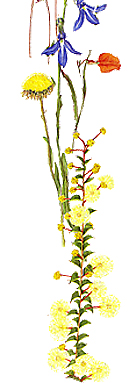
- Vision
- A Fighter
- Our Citizen
Sunshine Coast Daily 1 June 2002
KATHLEEN’S VISION GAVE COAST A GREEN FUTURE: Environmentalist devoted her life to preserving native vegetation
As an artist, author, educator and conservationist Kath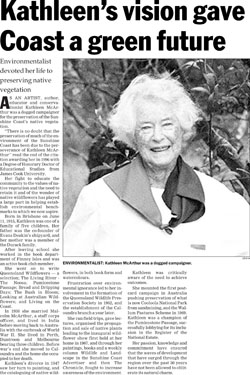 leen McArthur was a dogged campaigner for the preservation of the Sunshine Coast’s native vegetation.
‘There is no doubt that the preservation of much of the environment of the Sunshine Coast has been due to the perseverance of Kathleen McArthur,’ read the end of the citation awarding her in 1996 with a Degree of Honorary Doctor of Educational Studies from James Cook University. Her fight to educate the community to the values of native vegetation and the need to retain it and of the wonder of native wildflowers has played a large part in helping establish environmental benchmarks to which we now aspire.
Born in Brisbane on June 11, 1915, Kathleen was one of a family of five children. Her father was the co-founder of Evans Deakins shipyard, and her mother was a member of the Durack family. After leaving school she worked in the book department of Finney Isles and was an active book club member.
She went on to write Queensland Wildflowers––a selection; The Living River––The Noosa; Pumicestone Passage; Bread and Dripping Days; The Bush in Bloom; Looking at Australian Wildflowers; and Living on the Coast.
In 1938 she married Malcolm McArthur, a staff corps officer, and lived in India before moving back to Australia with the outbreak of World War II. She lived in Perth, Duntroon and Melbourne bearing three children. Before war’s end she moved to Caloundra and the home she occupied to her death.
Kathleen’s divorce in 1947 saw her turn to painting, and the cataloguing of native wildflowers, in both book form and watercolours. Frustration over environmental ignorance led to her involvement in the formation of the Queensland Wildlife Preservation Society in 1962, and the establishment of the Caloundra branch a year later. She ran field trips, gave lectures, organised the propagation and sale of native plants leading to the inaugural wildflower show first held at her home in 1967, and through her paintings, books and a weekly column Wildlife and Landscape in the Sunshine Coast Advertiser and then The Chronicle, fought to increase awareness of the environment.
Kathleen was critically aware of the need to achieve outcomes. She mounted the first postcard campaign in Australia pushing preservation of what is now Cooloola National Park from sandmining, and the Wallum Pastures Scheme in 1969. Kathleen was a champion of the Pumicestone Passage, successfully lobbying for its inclusion in the Register of the National Estate.
Her passion, knowledge and commitment have ensured that the waves of development that have surged through the region over the past 30 years have not been allowed to obliterate its natural charm.
Reproduced with permission of Sunshine Coast Newspapers
© WPSQ, Sunshine Coast & Hinterland Inc
Sunshine Coast Daily 8 June 2002
A TIGERISH fighter for the enviro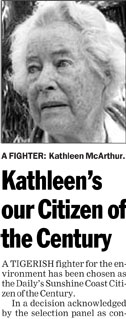 nment has been chosen as the Daily’s Sunshine Coast Citizen of the Century.
In a decision acknowledged by the selection panel as controversial, the late Caloundra-based conservationist, artist, author, educator and activist Kathleen McArthur was chosen ahead of several other nominees who have been major contributors to the Coast’s growth and prosperity. Included among them were long-time Maroochy shire chairman Eddie De Vere, who virtually dragged the shire out of rural obscurity through his pursuit of balanced development, and philanthropist and developer Des Scanlan.
The panel, however, felt that Kathleen McArthur's passionate commitment, meticulous research and articulate advocacy contributed so significantly to the preservation of the environment that she fully deserves this honoured place in the region’s history.
Our Citizen of the Century not only fought and won many significant battles for our waterways, beaches, wildlife and landscape, but played a pivotal role in educating the public to an awareness of environmental fragility.
Reproduced with permission of Sunshine Coast Newspapers
© WPSQ, Sunshine Coast & Hinterland Inc
Sunshine Coast Daily 8 June 2002
OUR CITIZEN OF THE CENTURY
Kathleen McArthur has outshone a fine selection of 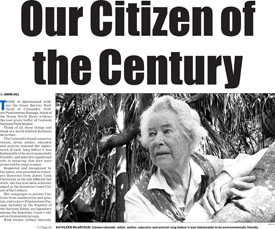 candidates to be honoured as the Sunshine Coast Daily’s Citizen of the Century.
Readers nominated citizens they considered to have made important contributions to the Sunshine Coast in the period from 1900–2000. Many worthy names were not among those nominations, including humanitarian Sir Clem Renouf, politician David Low, who drove construction of the coast road from Caloundra to Noosa, environmentalist Dr Arthur Harrold and one-time Premier Sir Frank Nicklin.
Kathleen McArthur died in 2000, aged 84. She left behind a legacy which will guarantee the Sunshine Coast retains as its point of difference the wonders of the natural environment.
The Sunshine Coast Daily Kathleen McArthur Memorial Scholarship is being set up at the University of the Sunshine Coast in her honour. The $3500 scholarship will be awarded annually to a Sunshine Coast high school student entering the university’s Bachelor of Science (Environmental Science) program in the Faculty of Science.
It will form a lasting tribute to a woman who showed that it is possible for individuals to make a difference: Kathleen McArthur––naturalist, environmental activist, artist, author––our Citizen of the Century.
[Main article by Janine Hill]
Think of Queensland without the Great Barrier Reef, think of Caloundra without Pumicestone Passage, think of the Noosa North Shore without the cool green buffer of Cooloola National Park behind. Think of all these things and think of a world without Kathleen McArthur.
The Caloundra-based conservationist, artist, author, educator and activist realised the importance of each, long before it was fashionable to be environmentally friendly, and played a significant role in ensuring that they were preserved for years to come.
Respected and recognised by her peers, and awarded an honorary doctorate from James Cook University in the late 1990s for her work, she has now been acknowledged as the Sunshine Coast Citizen of the Century.
Her campaigns to protect Cooloola from sandmining and grazing, and to have Pumicestone Passage included in the Register of the National Estate, are legendary among the Sunshine Coast’s oldest environmental groups.
With Doctor Arthur Harrold, the secretary of the Noosa Parks Association, she was a key figure in a 20-year battle to convince the State Government to gazette Cooloola National Park.
However, the changes she helped make to attitudes are perhaps also as important. Jan Oliver, the director of the Wildlife Preservation Society of Queensland, credits Kathleen, as well as the other founding members of the Society––Judith Wright, David Fleay and Brian Clouston––with raising an awareness of environmental issues in Queensland for the first time. ‘They were really responsible for getting the ordinary Australian to demand that the Great Barrier Reef be protected, and subsequently the Marine Protection Authority was set up and the reef was protected, against the Queensland Government,’ she said.
Ms Oliver said the society would probably not exist if it had not been for Kathleen. ‘Also we wouldn’t have the knowledge of so many beautiful plants and the paintings that she did on the Sunshine Coast,’ she said.
It was a passion for wildflowers that led to Kathleen’s devotion to wider conservation issues, but family and friends find it difficult to pinpoint where it all began. Her sister, Judy Nelson-Gracie, said Kathleen was always interested in the outdoors when they were growing up in the 1920s in the then semi-rural area of Coorparoo, Brisbane. ‘She was interested in everything,’ she said.
Cate Thynne, one of Kathleen’s three children, remembers her mother determinedly trying to sketch flowers with an early model, but very leaky, Biro. She said her mother would go the ‘ends of the earth’ to find out the names of things. ‘Once she started on the natural history, there was no stopping her,’ she said.
Kathleen’s ‘all-consuming’ passion extended from producing exquisite paintings of wildflowers, to growing them, selling them, writing about them, and so followed more than six books, as well as smaller booklets. Brian Clouston, the founder of Jacaranda Press, which published her first book, remembers her botanical paintings as ‘outstanding’. ‘It was a beautiful book, it really was, particularly in those days,’ he said.
Kathleen became keenly interested in the wallum country and dunal areas, and tigerishly opposed any development that would interfere with either.
In 1962, she helped form the Queensland Wildlife Preservation Society, and soon after, established the Caloundra branch.
Jillian Rossiter, past-president of the Sunshine Coast Environment Council, and Jill Chamberlain, honorary secretary of the Wildlife Preservation Society of Caloundra [sic], credit Kathleen with breaking new ground in environmental campaigns. ‘She was the first person in Australia, the first environmentalist, to run a postcard campaign. In the ‘60s, she had postcards printed so that people could fill in the postcards and send them to those in authority,’ she said.
While Kathleen was a thorn in the side of bureaucracy and of the government led by Sir Joh Bjelke-Petersen, his successor, Mike Ahern, had a healthy respect for Kathleen and her achievements. She had many discussions with the MP after he was elected to parliament in 1968 and he later set up the Beach Protection Authority. Mr Ahern said the Sunshine Coast could well have been a different place if it had not been for Kathleen’s efforts to raise awareness of the need to protect the natural environment. ‘She played her part, along with others, in ensuring that it didn’t become an endless, sprawling kind of urbanity,’ he said.
Both Jillian Rossiter and Jill Chamberlain regard Kathleen as a woman before her time, speaking out––when women generally didn’t––about saving an environment that many thought didn’t need to be saved. ‘It was so difficult for her in that time because she was a female. But Kathleen had such a presence, she was well educated, she was a dignified person, and she was so articulate, that people had to take notice of her,’ Jillian said.
Kathleen McArthur died in 2000, aged 84.
In recognition of her achievements, the Caloundra Wildlife Preservation Society is seeking to have the Currimundi Conservation park renamed in her honour.
Golden Beach State School, for which she wrote a book, Little Fishes of Pumicestone Passage, also has a wallum garden dedicated to her memory.Reproduced with permission of Sunshine Coast Newspapers
© WPSQ, Sunshine Coast & Hinterland Inc